Description
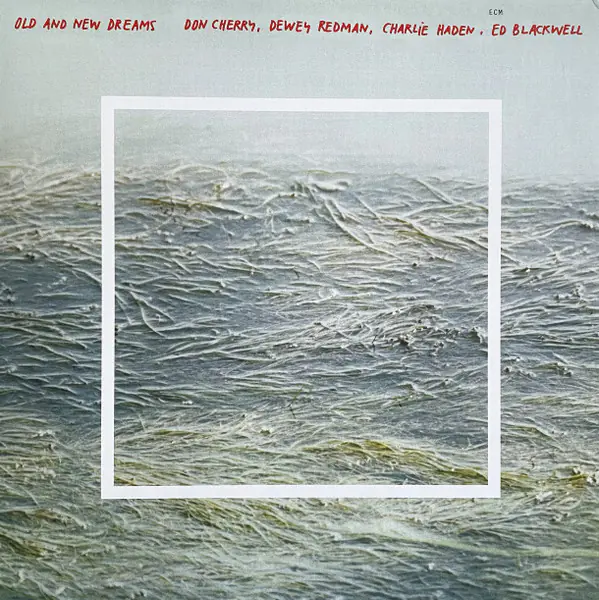
Old And New Dreams – Old And New Dreams – Vinyl Record
Don Cherry, Dewey Redman, Charlie Haden and Ed Blackwell came together to celebrate the work of mentor Ornette Coleman.
Old and New Dreams (1979) is the self-titled debut album by Old and New Dreams, a quartet formed by former members of the Ornette Coleman groups of the late 1950s and early ’60s. Featuring Don Cherry (trumpet), Dewey Redman (tenor saxophone), Charlie Haden (bass), and Ed Blackwell (drums), the band represented both a continuation and a reimagining of the free jazz revolution they had helped ignite two decades earlier. The album is a powerful statement of collective identity—honoring Coleman’s harmolodic legacy while asserting a mature, deeply conversational group sound.
By the late 1970s, free jazz had already splintered into many directions: loft jazz in New York, European free improvisation, and more structured post-bop hybrids. Old and New Dreams stands apart because it reunites musicians who had already internalized the radical ideas of Ornette Coleman—melodic freedom, rhythmic elasticity, and non-hierarchical ensemble interplay—and filters them through years of individual growth. Rather than sounding chaotic or confrontational, the album feels intentional, spacious, and rooted.
The record includes both original compositions and reinterpretations of Coleman’s music, reinforcing the group’s conceptual bridge between past and present. Don Cherry’s “Lonely Woman,” originally recorded by Coleman in 1959, is revisited with reverence but not imitation. The melody remains haunting and open, yet the quartet’s interplay gives it a warmer, more reflective aura. Redman’s tenor tone is robust and slightly gritty, contrasting with Cherry’s lyrical, almost folk-like trumpet phrasing. Haden and Blackwell anchor the piece with a flexible rhythmic pulse that breathes rather than drives.
Cherry’s “Togo” and “Guinea” introduce subtle global influences, reflecting his growing interest in non-Western musical traditions during the 1970s. The grooves are understated yet propulsive, shaped by Blackwell’s crisp, responsive drumming and Haden’s resonant bass lines. The rhythm section doesn’t simply accompany; it participates equally in shaping melodic direction and emotional contour.
Charlie Haden’s “Song for the Whales” brings a contemplative, almost pastoral mood to the album. Haden’s compositions often carried a quiet political or environmental resonance, and here the music unfolds slowly, with a sense of spacious lyricism. The quartet allows silence and sustain to become expressive tools, demonstrating their collective discipline and sensitivity.
What distinguishes Old and New Dreams from earlier free jazz recordings is its sense of cohesion and balance. There is freedom, but it’s not frenetic; abstraction, but not disconnection. Each musician listens deeply, responding in real time with restraint and empathy. The absence of piano or chordal instruments preserves harmonic openness, allowing melodies to float and intertwine without fixed boundaries.
The album’s title encapsulates its philosophy. “Old” references the shared history of these musicians within Ornette Coleman’s groundbreaking ensembles. “New” acknowledges their evolution and the fresh contexts in which they now operate. Rather than attempting to recreate the shock of early free jazz, they offer something more enduring: a mature, dialogic approach to improvisation that feels both grounded and exploratory.
In the broader arc of jazz history, Old and New Dreams stands as a testament to the longevity of the harmolodic concept. It shows that free jazz, once seen as disruptive or chaotic, could age gracefully—retaining its openness while gaining depth and warmth. The album is not a radical manifesto but a confident affirmation of collective improvisation as an evolving art form.
For listeners interested in the continuation of Ornette Coleman’s vision through musicians who lived it firsthand, Old and New Dreams is essential. It captures a quartet of master improvisers finding common language again—rooted in shared history, reaching toward new horizons, and reminding us that in jazz, freedom is not an endpoint but an ongoing conversation.
Brand new, never played and still sealed in the factory plastic
Track Listing
Lonely Woman
Togo
Guinea
Open or Close
Orbit Of La-Ba
Song For Whales