Description
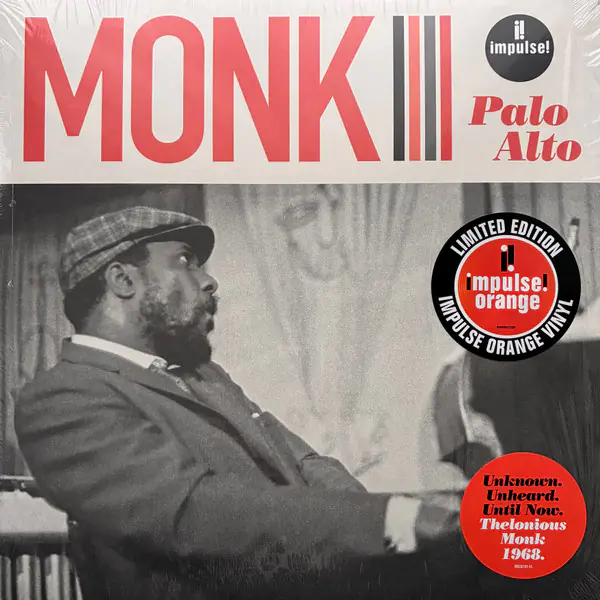
Thelonious Monk – Palo Alto – Orange Vinyl Record
Palo Alto is a remarkable live album by Thelonious Monk, documenting a previously unknown concert performed on October 27, 1968, at Palo Alto High School in California. Unearthed decades later and officially released in 2020, the recording quickly became one of the most significant jazz archival discoveries of the twenty-first century. More than merely a historical curiosity, Palo Alto captures Monk and his quartet in inspired form during the final years of his performing career, offering listeners a vivid portrait of one of jazz’s greatest innovators in a live setting.
The circumstances surrounding the concert are almost as extraordinary as the music itself. The performance was organized by a local high school student during a period of significant social and political tension in the United States. Against the backdrop of the civil rights movement, anti-war protests, and widespread cultural change, Monk agreed to perform at the school, creating a unique event that brought together students and community members from diverse backgrounds. The concert became a symbol of unity and artistic connection during a turbulent era.
By 1968, Thelonious Monk was already recognized as one of the most important composers and pianists in jazz history. Alongside figures such as Charlie Parker and Dizzy Gillespie, he had helped shape the bebop revolution of the 1940s. His compositions, characterized by angular melodies, unusual harmonies, rhythmic surprises, and distinctive structures, transformed the language of modern jazz. Yet despite his immense influence, relatively few high-quality live recordings from this period of his career had surfaced, making Palo Alto particularly valuable.
The album features Monk leading a superb quartet that included longtime collaborators. The ensemble demonstrates a deep understanding of Monk’s unique musical language, allowing the performances to unfold with both precision and spontaneity. The interaction among the musicians is one of the album’s greatest strengths, reflecting years of shared experience and mutual trust.
Musically, Palo Alto presents many of Monk’s most celebrated compositions. These pieces serve not only as examples of his compositional genius but also as vehicles for improvisation and reinterpretation. Hearing them performed live reveals how flexible and dynamic Monk’s music could be. Even compositions that had become jazz standards remain fresh and surprising in this setting, shaped by the energy of the moment and the creativity of the performers.
Monk’s piano playing throughout the concert is quintessentially his own. His touch is percussive yet lyrical, his phrasing unpredictable yet deeply logical. He approaches the keyboard with a sense of playfulness and invention that continually challenges conventional expectations. Moments of silence are used as effectively as notes, and his unique rhythmic conception gives the music a feeling of constant motion and surprise.
One of the album’s most compelling qualities is the atmosphere of the performance. Unlike studio recordings, which often emphasize precision and control, Palo Alto captures the immediacy of live music-making. Listeners can sense the interaction between the musicians and the audience, as well as the spontaneity that emerges from real-time improvisation. This energy brings an added dimension to Monk’s music, highlighting its vitality and unpredictability.
The recording also provides valuable insight into Monk’s late-career artistry. While some historical accounts focus on the challenges he faced during his final years, Palo Alto reminds listeners of his continued brilliance as a performer. The concert reveals a musician who remained deeply engaged with his material and capable of inspiring extraordinary performances from both himself and his collaborators.
The sound quality of the recording is surprisingly strong given its origins, allowing listeners to appreciate the nuances of the ensemble’s playing. Careful restoration work has preserved the character of the original performance while making it accessible to contemporary audiences. This technical achievement contributes significantly to the album’s impact and historical importance.
Upon its release, Palo Alto received widespread acclaim from critics, historians, and jazz fans. Many regarded it as one of the most important archival jazz releases in recent memory, praising both the quality of the performance and the remarkable story behind its discovery. The album introduced new listeners to Monk’s artistry while providing longtime admirers with valuable new material from a crucial period of his career.
Beyond its historical significance, Palo Alto succeeds because the music itself is extraordinary. The performances capture everything that makes Monk such a compelling artist: originality, humor, sophistication, unpredictability, and emotional depth. The concert demonstrates how his compositions continued to evolve in performance and how his distinctive musical vision remained as powerful as ever.
With its inspired musicianship, fascinating backstory, and exceptional historical value, Palo Alto stands as one of the most important jazz discoveries of recent decades. The album captures Thelonious Monk in a rare and intimate live setting, offering a fresh perspective on one of the most influential figures in modern music. Inventive, joyful, and endlessly engaging, Palo Alto is both an essential document of jazz history and a thrilling listening experience in its own right.
Brand new, never played and still sealed in the factory plastic
Track Listing
Ruby, My Dear
Well, You Needn’t
Don’t Blame Me
Blue Monk
Epistrophy
I Love You Sweetheart Of All My Dreams