Description
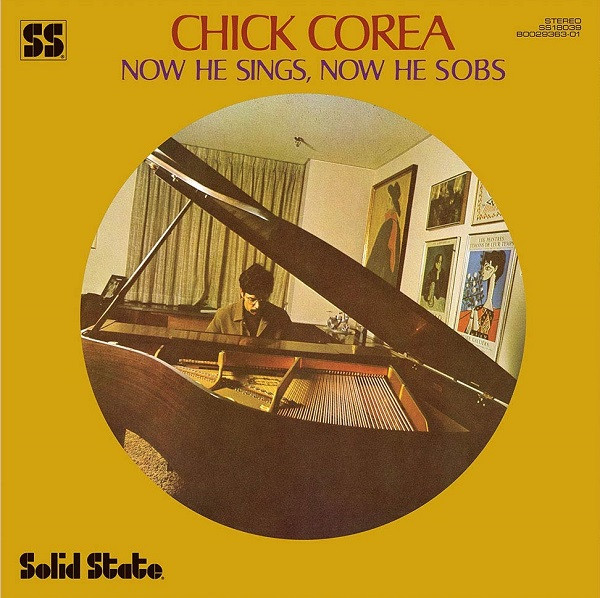
Chick Corea – Now He Sings, Now He Sobs – 180 Gram Vinyl Record
A Daring, Expressive Milestone in Post-Bop and Modern Jazz Piano
Released in 1968 on Solid State Records, Now He Sings, Now He Sobs is the breakthrough trio album by legendary jazz pianist and composer Chick Corea. Widely considered one of the most influential piano trio recordings in jazz history, the album showcases Corea in peak exploratory form, joined by Miroslav Vitouš on bass and Roy Haynes on drums. More than five decades later, Now He Sings, Now He Sobs still resonates as a vital, fearless, and richly expressive work that helped reshape the modern jazz landscape and foreshadowed the directions Corea would pursue throughout his prolific career.
At the time of the album’s release, Chick Corea was still in his 20s but already gaining a reputation as a virtuoso pianist with a forward-thinking approach. He had played with Blue Mitchell, Stan Getz, and Sarah Vaughan, and had recently released his debut album Tones for Joan’s Bones. But Now He Sings, Now He Sobs was something entirely different—a bold and deeply personal artistic statement that merged the traditions of bebop with avant-garde improvisation, modal exploration, and an almost classical sense of structure and form.
The album is known for its freewheeling energy, advanced harmonic vocabulary, and remarkably interactive trio playing. Unlike the more polished, subdued trio recordings of the era, Corea’s trio here plays with a sense of urgency, spontaneity, and experimentation that feels as alive today as it did in 1968. This was not background music—it was a declaration of creative independence, just before Corea would join Miles Davis in a series of electric experiments that would help launch the jazz fusion movement.
The opening track, “Steps – What Was,” is a masterclass in dynamic tension and release. It begins with a jagged, asymmetrical motif that opens into cascading runs and angular phrasing, as Corea’s left hand punctuates the rhythm with almost percussive drive. Roy Haynes’ drumming is not simply supportive—it is dialogic, responding and provoking in equal measure. Miroslav Vitouš’s bass lines dance freely, sometimes anchoring the harmony and sometimes pushing against it. This track alone has become a template for modern piano trio performance, studied by generations of jazz musicians for its blend of structure and freedom.
The title track, “Now He Sings, Now He Sobs,” leans into Corea’s love of modal improvisation and compositional shape. Built around open harmonies and scalar movement, the piece shifts between introspective passages and sudden bursts of energy. Here, Corea’s playing becomes almost orchestral—his phrasing is wide, his dynamics sweeping, and his use of space carefully measured. There are echoes of Thelonious Monk’s rhythmic displacement, Bill Evans’ harmonic sophistication, and Cecil Taylor’s abstraction, but Corea distills them into a sound that is uniquely his own.
Other tracks like “Matrix” provide a more straight-ahead post-bop burn, with rapid-fire lines and tight rhythmic interplay that showcase Corea’s technical prowess and Haynes’ explosive creativity. The trio’s version of “My One and Only Love”—a bonus track on many reissues—provides a brief, lyrical counterpoint to the more adventurous original compositions, demonstrating Corea’s ability to infuse tenderness and melodic clarity even in a free-flowing setting.
The album’s title—and indeed its performances—evoke a sense of duality: the tension between order and chaos, melody and abstraction, control and release. This dualism is central to Corea’s artistry, and it echoes throughout his career, from the acoustic purity of his work with Return to Forever to his classical excursions and intimate duets with Gary Burton.
In terms of production, Now He Sings, Now He Sobs captures the trio with a raw, immediate clarity. Unlike the heavily produced jazz-fusion records Corea would later contribute to, this album is direct and intimate—you can hear the mechanics of the piano, the brush of stick on cymbal, the pluck of the bass string. This sonic transparency enhances the album’s feeling of liveness, making the listener feel like a silent observer in the studio as three master musicians push each other toward new heights.
The album was not an immediate commercial hit upon its initial release, but its influence has grown steadily over the decades. Today, it is universally regarded as one of the greatest jazz piano trio albums ever recorded, cited alongside Bill Evans’ Sunday at the Village Vanguard and Keith Jarrett’s Standards Trio recordings. Its spirit of experimentation and expressive freedom has influenced countless pianists—from Brad Mehldau and Vijay Iyer to Hiromi and Aaron Parks.
Now He Sings, Now He Sobs is a landmark achievement in modern jazz, a fearless record that captures Chick Corea at a moment of creative breakthrough. It balances innovation with lyricism, fire with grace, and chaos with clarity. For any listener interested in the evolution of jazz piano, the possibilities of trio interplay, or the broader trajectory of post-bop and free jazz, this album is not just recommended—it’s essential. Whether you’re a jazz newcomer or a seasoned aficionado, Now He Sings, Now He Sobs remains one of the most exhilarating and emotionally potent recordings ever made in the genre.
Brand new, never played and still sealed in the factory plastic
Track Listing
Steps – What Was
Matrix
Now He Sings – Now He Sobs
Now He Beats The Drum – Now He Stops
The Law Of Falling And Catching Up