Description
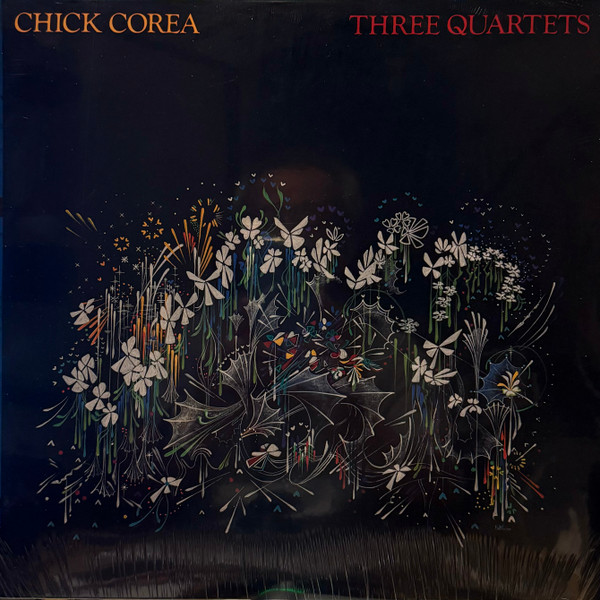
Chick Corea – Three Quartets – Vinyl Record
Three Quartets is one of the most celebrated and compositionally ambitious works by legendary jazz pianist Chick Corea, recorded in January 1981 and released the same year on Stretch Records (originally on Warner Bros). This album showcases Corea’s profound skills as a composer and pianist, exploring the quartet format in a highly structural yet emotionally dynamic way. It’s a perfect convergence of classical form, post-bop jazz sensibility, and Corea’s own unique harmonic language.
As the title suggests, the album is centered around three extended quartets, not just in terms of ensemble but also compositional intent: these are deliberate, suite-like pieces, each one unfolding in movements, with tightly constructed themes and clear emotional arcs. The personnel assembled for this session is nothing short of legendary: Chick Corea on piano, Michael Brecker on tenor saxophone, Eddie Gómez on bass, and Steve Gadd on drums. Each player brings formidable improvisational prowess and deep sensitivity, making the record as much about interplay and real-time invention as about formal writing.
Quartet No. 1 (Parts I & II)
The first suite opens the album with deep spiritual gravitas. Part I begins with a mysterious, slow piano ostinato, gradually joined by the others in a dark and brooding build. It feels both suspended and driven, deeply modal but structurally firm. Michael Brecker’s tenor sax soars here—fiery yet restrained—while Gadd’s drumming is spacious but precise, pushing the ensemble in nuanced, shifting polyrhythms. Part II accelerates the tempo and energy, weaving complex interplay between Corea’s percussive comping and Brecker’s angular melodic lines. The piece evolves organically, alternating between intense improvisation and through-composed motifs.
Quartet No. 2 (Parts I & II)
These two movements are tributes to Duke Ellington and John Coltrane, respectively, two giants whose influence looms large over Corea’s entire career. The Duke Ellington tribute (Part I) is more swinging and lyrical, evoking Ellington’s elegance without imitation. There’s a delicacy and warmth in Corea’s voicings here that contrasts with the more abstract energy of the first quartet. Part II, dedicated to Coltrane, is explosive and searching—driven by rapid modal runs, urgent drumming, and a sense of spiritual striving. Brecker in particular channels Trane’s spirit, delivering some of the album’s most impassioned and expansive solos.
Quartet No. 3
Shorter and more intimate, the third quartet is more reflective, almost chamber-like. The mood is subdued, the dynamics delicate. Corea’s piano work here is impressionistic, and the ensemble plays with space and tension rather than velocity. It feels like a cool-down, a place of resolution and quiet exploration after the intensity of the previous two quartets.
Three Quartets is often cited as one of Chick Corea’s finest acoustic albums. While he was known for his electric work with Return to Forever and his trailblazing fusion efforts, this record demonstrates his absolute command over acoustic, composition-forward jazz. It bridges classical formality with the freedom of modern post-bop, all executed with exceptional technical command and deep musical emotion.
The album is a masterclass in modern jazz quartet writing. It’s not just a jam session by great players—it’s a carefully constructed, emotionally rich, and harmonically deep work of art. For musicians and jazz listeners alike, Three Quartets represents a kind of summit: formal elegance meets improvisational fire.
Brand new, never played and still sealed in the factory plastic
Track Listing
Quartet No. 1
Quartet No. 3
Quartet No. 2 (Part 1) (Dedicated To Duke Ellington)
Quartet No. 2 (Part 2) (Dedicated To John Coltrane)