Description
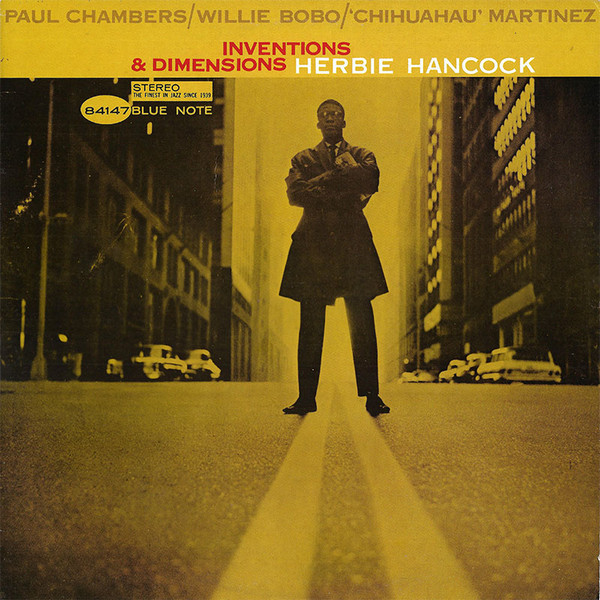
Herbie Hancock – Inventions & Dimensions – 180 Gram Vinyl Record
By the time Inventions & Dimensions was released in August 1964, Herbie Hancock had already begun establishing himself as one of the most exciting young pianists in jazz. At just 24 years old, he was gaining recognition both as a sideman with Miles Davis and as a budding bandleader. Following his more structured, hard-bop albums like Takin’ Off (1962) and My Point of View (1963), Hancock took a sharp turn toward experimentation, delivering an album that was highly improvisational, rhythmically complex, and deeply influenced by Latin and Afro-Cuban jazz traditions.
Unlike many of his previous recordings, which relied on traditional melodies and tight arrangements, Inventions & Dimensions is almost entirely built around rhythm and spontaneous improvisation. It’s an album that feels more like a free-flowing conversation between musicians than a structured composition, highlighting Hancock’s fearless approach to jazz innovation.
Musically, Inventions & Dimensions is strikingly minimalist yet incredibly rich. Hancock opted for an unconventional quartet, featuring:
Herbie Hancock on piano, leading the session with his signature fluid, expressive playing.
Paul Chambers on bass, providing a steady yet flexible foundation, allowing Hancock’s improvisations to feel grounded yet unpredictable.
Willie Bobo on drums and timbales, bringing a Latin-jazz flavor with complex polyrhythms.
Osvaldo Chihuahua Martínez on percussion (congas and bongos), further enhancing the Afro-Cuban and Latin influences with deep, earthy grooves.
Notably, there are no horns—a bold choice for a jazz album at the time. This allows Hancock’s piano playing to take center stage, weaving effortlessly between the layers of percussion and bass. The result is a sound that feels intimate yet adventurous, structured yet unpredictable.
While many jazz records from this era focused on melodic development, Inventions & Dimensions prioritizes rhythmic interplay and harmonic exploration, making it one of Hancock’s most unique and progressive works.
Since the album is almost entirely instrumental, its lyrics are essentially Hancock’s piano improvisations, communicating emotion, movement, and energy without words. Instead of following traditional jazz song structures, Hancock allows his melodies to emerge organically, shifting between moments of delicate introspection and explosive rhythmic bursts.
Each track feels like a musical conversation, where the rhythm section constantly pushes Hancock to explore new harmonic ideas and unexpected phrasing. There’s an almost cinematic quality to the music—it’s easy to imagine the album as the soundtrack to a late-night cityscape or an abstract painting coming to life.
Key Tracks: The Core of Hancock’s Experimentation
Succotash – A thrilling opener that immediately establishes the album’s rhythmic focus. The interplay between Hancock’s stuttering, fragmented piano lines and the percussion section makes it feel almost like a playful, modern dance.
Triangle – A track that slowly unfolds, with hypnotic basslines and rich harmonic textures. Hancock’s piano work here is both meditative and daring, balancing sparse, lyrical moments with quick bursts of improvisation.
Jack Rabbit – One of the more energetic pieces, featuring rapid, bouncing piano runs over a dense, percussive groove. There’s a sense of playfulness and freedom, making it one of the most engaging tracks on the album.
Mimosa – A slower, more contemplative piece that shows Hancock’s ability to create depth and atmosphere with minimalism.
A Jump Ahead – A high-energy closer that brings the album full circle, ending on a note of explosive, rhythmic intensity.
Each track feels spontaneous yet cohesive, as if Hancock and his band are building the music in real time, reacting to one another with every note.
Upon release, Inventions & Dimensions was not an immediate commercial success, but it quickly became recognized as a groundbreaking album in Hancock’s catalog. It showed that he was not just a technically gifted pianist, but also a true innovator, willing to push the boundaries of what jazz could be.
While jazz at the time was shifting toward freer, more avant-garde expressions, Hancock’s approach here was different from the dissonant, chaotic energy of free jazz pioneers like Ornette Coleman. Instead of abandoning structure completely, Hancock stripped jazz down to its rhythmic core, proving that improvisation could be built around groove as much as melody.
Many of the ideas explored on Inventions & Dimensions would later resurface in Hancock’s future work, particularly in his more fusion-oriented records of the 1970s. His exploration of Latin rhythms, modal improvisation, and open-ended structures would heavily influence later jazz-funk masterpieces like Head Hunters (1973).
While Inventions & Dimensions may not be as widely celebrated as Maiden Voyage (1965) or Head Hunters (1973), it remains one of Herbie Hancock’s most fascinating and daring albums. It captures a young artist at a creative crossroads, embracing experimentation, rhythm, and spontaneity in ways that few pianists had done before.
For jazz fans who appreciate the interplay of percussion and improvisation, Inventions & Dimensions is a must-listen. It’s a record that rewards deep listening, revealing new details with each play—whether it’s a subtle shift in groove, a surprising chord change, or a hypnotic bassline buried beneath the layers of percussion.
Decades later, the album still feels bold, fresh, and boundary-pushing, proving that even in his early years, Herbie Hancock was always looking forward—always searching for new dimensions in sound.
Originally released in 1964 by Blue Note Records
Brand new, never played and still in the factory plastic sealed
Track Listing
Succotash
Triangle
Jack Rabbit
Mimosa
A Jump Ahead