Description
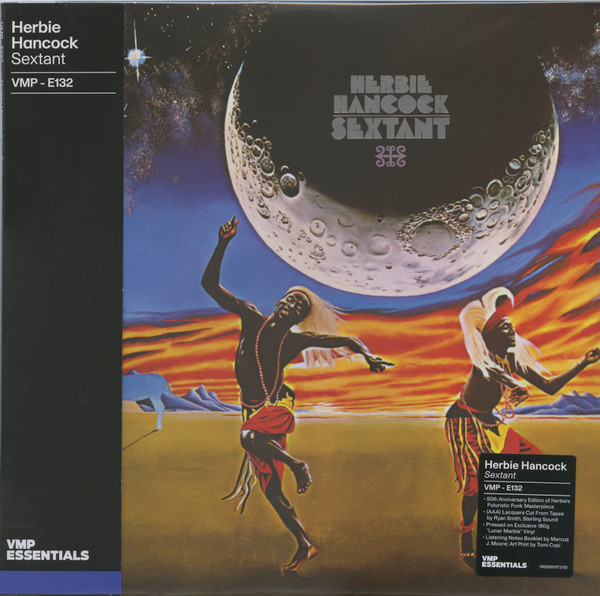
Herbie Hancock – Sextant – 180 Gram Lunar Marble Vinyl Record
Vinyl Me, Please Essentials – VMP-E132 — December 2023
50th anniversary edition of Herbie’s futuristic funk masterpiece
(AAA) Lacquers cut from tapes by Ryan Smith, Sterling Sound
Pressed on exclusive 180G lunar marble vinyl
Listening notes booklet by Marcus J Moore, Art print by Tomi Copi
8 page 10’x10′ booklet with commentary by Marcus M. Moore
12′ x 12′ b&w photo on card stock paper by Tomi Copi / Michael Ochs Archives
Sextant is Herbie Hancock’s futuristic funk masterpiece and the VMP Essentials Record of the Month for December 2023. The 50th anniversary-edition record is available on 180g ‘Lunar Marble’ vinyl with AAA lacquers cut from tapes by Ryan Smith at Sterling Sound.
Brand new, never played and still in the factory plastic
Sextant is a groundbreaking jazz-fusion album by the legendary pianist and composer Herbie Hancock, released in March 1973 on Columbia Records. This album is notable for its experimental nature and its innovative use of electronic instruments, making it one of Hancock’s most avant-garde works. Sextant is the final album recorded by Hancock’s Mwandishi Sextet, a group known for pushing the boundaries of jazz through the use of complex rhythms, abstract structures, and a heavy emphasis on electronic textures.
Background
Herbie Hancock, who first gained fame as a member of the Miles Davis Quintet in the 1960s, was already an established and influential figure in jazz by the time he formed the Mwandishi Sextet in 1970. The Sextet, named after Hancock’s Swahili name, Mwandishi (meaning ‘composer’), was his first major foray into electric jazz. The group’s music was deeply influenced by the avant-garde, free jazz, and the burgeoning world of electronic music, reflecting Hancock’s desire to explore new sonic territories.
Sextant is the third and final album by the Mwandishi Sextet, following ‘Mwandishi’ (1971) and ‘Crossings’ (1972). The album represents the culmination of Hancock’s experiments with electronic sounds, including the use of synthesizers and electronic effects, which were still relatively new in the jazz world at the time. ‘Sextant’ is often regarded as one of the most challenging and forward-thinking albums in Hancock’s discography, laying the groundwork for his later work, particularly the seminal ‘Head Hunters’ (1973).
Sextant consists of three long-form compositions, each of which showcases the group’s ability to blend jazz improvisation with complex electronic soundscapes.
‘Rain Dance’ – The opening track is a highly experimental piece that features the use of the ARP 2600 synthesizer, which creates a complex and abstract soundscape. The track’s rhythm is irregular, with Hancock using electronic effects to create a sense of unpredictability and disorientation. ‘Rain Dance’ is one of the most iconic examples of Hancock’s pioneering use of electronic instruments in jazz.
‘Hidden Shadows’ – The second track is more groove-oriented than ‘Rain Dance,’ with a stronger rhythmic foundation provided by drummer Billy Hart and bassist Buster Williams. Despite this, the track remains deeply experimental, with dense layers of synthesizers, electric piano, and woodwinds creating a rich, immersive atmosphere. The interplay between acoustic and electronic elements makes ‘Hidden Shadows’ a fascinating study in contrast.
‘Hornets’ – The final track on the album is the longest, clocking in at over 19 minutes. ‘Hornets’ is a sprawling, free-form composition that blends improvisation with structured sections. The piece features aggressive horn lines, courtesy of Eddie Henderson (trumpet), Bennie Maupin (bass clarinet), and Julian Priester (trombone), alongside Hancock’s electric piano and synthesizers. The track builds in intensity, creating a sense of controlled chaos that characterizes much of the album.
Sextant is an album that defies easy categorization, blending elements of jazz, electronic music, and avant-garde experimentation. The album’s title refers to the navigational instrument, which is fitting given the album’s exploratory nature—Hancock and his band are navigating uncharted musical waters, pushing the boundaries of what jazz could be.
The use of electronic instruments, particularly synthesizers, is a defining feature of the album. Hancock’s pioneering use of the ARP 2600 and other electronic devices allowed him to create sounds that were entirely new to the jazz world, blending them seamlessly with the acoustic instruments of the Sextet. The result is a sound that is both futuristic and deeply rooted in jazz tradition, combining improvisation with a carefully crafted sonic landscape.
Lyrically and conceptually, the album is abstract, with the music itself taking center stage. The tracks evoke a range of emotions and atmospheres, from the disorienting and alien soundscapes of ‘Rain Dance’ to the intense, almost aggressive energy of ‘Hornets.’ The album’s themes are largely left to the listener’s interpretation, adding to its mystique and enduring appeal.
At the time of its release, Sextant received mixed reviews, with some critics praising its innovation and others finding it too abstract and difficult to access. However, in the years since its release, the album has gained a reputation as one of Hancock’s most important and influential works. It is now seen as a precursor to his later, more commercially successful albums like ‘Head Hunters,’ which continued to explore the fusion of jazz with electronic music but in a more accessible way.
Sextant is often cited as a key album in the development of jazz fusion and electronic jazz, influencing not only Hancock’s subsequent work but also the broader genre. The album’s experimental approach has inspired countless musicians in jazz, electronic music, and beyond, cementing its place as a landmark in the history of both jazz and electronic music.
Sextant stands as a testament to Herbie Hancock’s willingness to take risks and push the boundaries of what jazz could be. The album’s fusion of electronic sounds with jazz improvisation was ahead of its time and continues to influence musicians across genres.
For fans of jazz fusion, electronic music, and avant-garde jazz, Sextant is an essential listen that captures a moment of intense creativity and exploration in Herbie Hancock’s career. The album remains a cornerstone of Hancock’s discography and a key work in the evolution of modern jazz.
Track Listing
Rain Dance
Hidden Shadows
Hornets