Description
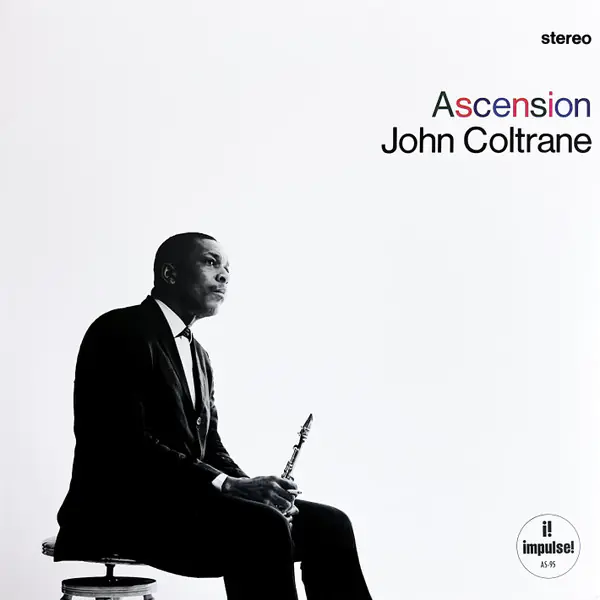
John Coltrane – Ascension – Vinyl Record
Released in 1966, Ascension is one of the most radical and polarizing works in the discography of John Coltrane—and in jazz history more broadly. It marks a decisive leap into the avant-garde, pushing beyond even the spiritual and modal explorations of his earlier 1960s recordings. Structured as a single, extended piece performed by a large ensemble, Ascension abandons conventional melody, harmony, and song form in favor of collective improvisation, density, and raw expressive force.
The album features an expanded group of eleven musicians, including key figures in the emerging free jazz movement such as Pharoah Sanders, Freddie Hubbard, and Archie Shepp. The structure loosely alternates between full ensemble passages—where all players contribute to a turbulent, almost chaotic wall of sound—and individual solos, where each musician explores their own sonic vocabulary. These solos are not neatly contained or traditionally “resolved”; instead, they feel like extensions of the collective energy, emerging from and dissolving back into the group’s intensity.
Stylistically, Ascension is often compared to the work of Ornette Coleman, particularly his 1960 album Free Jazz: A Collective Improvisation, which similarly used a large ensemble to explore free-form improvisation. However, Coltrane’s approach is arguably more spiritual and overwhelming in its emotional scope. Where Coleman’s work can feel exploratory and conversational, Ascension is frequently described as ecstatic, even confrontational—a sonic attempt to reach transcendence through sheer intensity.
This intensity is closely tied to Coltrane’s spiritual evolution during this period. Following works like A Love Supreme, his music increasingly sought to express ideas of universal consciousness, devotion, and liberation. On Ascension, that pursuit becomes less about structured expression and more about total immersion. The music doesn’t guide the listener in a traditional sense; it engulfs them, demanding active engagement and openness to abstraction. For some listeners, this can feel overwhelming or inaccessible, while for others, it represents one of the purest forms of musical and spiritual expression.
One of the most notable aspects of Ascension is its rejection of hierarchy. Although Coltrane is the central figure, the album emphasizes collective creation over individual virtuosity. Even during solo sections, the boundaries between leader and ensemble blur, reinforcing the idea that the music is a shared, communal act. This mirrors broader cultural and artistic shifts of the 1960s, when many artists were challenging traditional structures and seeking new forms of expression.
Historically, Ascension was—and remains—divisive. Some critics and listeners at the time viewed it as a bold, necessary evolution of jazz, while others saw it as a departure into formless noise. That tension is part of what gives the album its enduring significance. It represents a moment when jazz, as a genre, was being redefined in real time, stretching its limits and questioning its own foundations.
Ascension is less an album in the conventional sense and more an experience—one that prioritizes emotion, energy, and spiritual searching over structure or accessibility. It stands as a landmark of avant-garde jazz, capturing a point where John Coltrane pushed his music to its outermost edges, inviting listeners to follow him into uncharted territory.
Brand new, never played and still in the factory plastic
Track Listing
Ascension (Part 1)
Ascension (Part 2)