Description
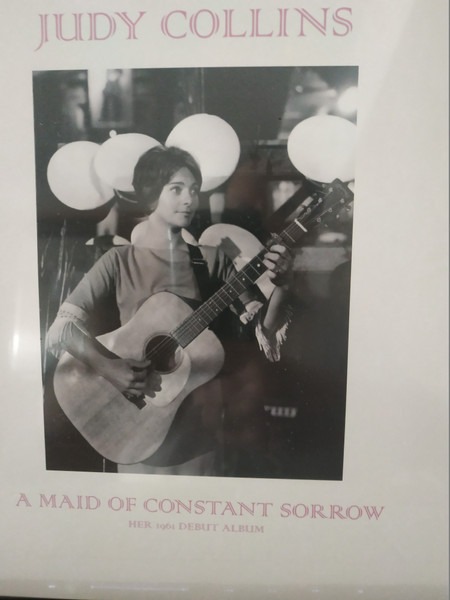
Judy Collins – A Maid Of Constant Sorrow – Vinyl Record
A Maid of Constant Sorrow is the debut album by Judy Collins, released in 1961. It introduced one of the most distinctive voices of the American folk revival and established Collins as a gifted interpreter of traditional songs long before she became known for contemporary songwriters such as Joni Mitchell, Leonard Cohen, and Bob Dylan. Rooted almost entirely in traditional British, Irish, and American folk music, the album is a beautifully understated debut that reflects both Collins’ classical vocal training and her deep respect for folk traditions.
Released during the height of the early-1960s folk revival, A Maid of Constant Sorrow arrived at a time when artists were rediscovering centuries-old ballads, Appalachian songs, spirituals, and work songs. Alongside performers such as Joan Baez, Odetta, and The Kingston Trio, Collins helped introduce traditional music to a new generation of listeners.
Unlike many later albums in her catalog, which featured lush orchestral arrangements and contemporary compositions, A Maid of Constant Sorrow is strikingly minimalist. The emphasis is placed squarely on the songs themselves, with sparse accompaniment that allows the melodies and lyrics to retain their historical character.
Collins’ voice is the album’s defining feature. Even at the beginning of her recording career, her soprano possessed remarkable purity, control, and emotional sensitivity. Influenced by her background as a classical pianist and vocalist, she approached folk songs with exceptional precision while avoiding excessive ornamentation. Her performances are intimate and deeply respectful of the material, allowing centuries-old stories to speak for themselves.
The repertoire draws heavily from traditional Anglo-American folk music, including ballads, love songs, and Appalachian standards. Many of these songs had been passed down orally through generations before being collected by folklorists, making the album as much an act of preservation as a commercial recording.
The arrangements are intentionally simple. Acoustic guitar serves as the principal accompaniment, occasionally joined by subtle additional instrumentation. This restraint creates a timeless atmosphere and highlights the emotional power of the lyrics.
The album’s title track, the traditional “Maid of Constant Sorrow,” exemplifies Collins’ interpretive strengths. Rather than dramatizing the song, she delivers it with quiet dignity, allowing its themes of longing, hardship, and resilience to emerge naturally. Her approach reflects the broader philosophy of the folk revival: authenticity over spectacle.
Lyrically, the songs explore enduring human experiences—love, separation, loss, hardship, hope, and perseverance. Although many originated centuries earlier, their emotional directness gives them a remarkable universality. Collins’ interpretations emphasize these timeless qualities, helping explain why the material continues to resonate with modern audiences.
The production is warm and unadorned, characteristic of early folk recordings. There are no elaborate studio effects or commercial embellishments; instead, the recording captures the intimacy of a live performance. This simplicity has allowed the album to age gracefully, avoiding many of the production trends that date recordings from the early 1960s.
Although A Maid of Constant Sorrow was not a major commercial success upon release, it quickly established Collins as one of the leading voices of the folk revival. It laid the foundation for a career that would later embrace contemporary songwriting, orchestral pop, and social commentary while always retaining a deep connection to traditional music.
Looking back, the album is significant not only as Judy Collins’ debut but also as a document of the American folk revival at one of its most authentic moments. Before she became famous for her interpretations of modern songwriters, Collins demonstrated that ancient folk songs could be performed with elegance, emotional depth, and artistic integrity.
With its crystalline vocals, understated arrangements, and deep reverence for traditional music, A Maid of Constant Sorrow remains one of the finest folk debuts of the early 1960s. It captures Judy Collins at the beginning of an extraordinary career while preserving a rich musical heritage with grace, intelligence, and timeless beauty. It is an essential recording for anyone interested in traditional folk music or the roots of the American folk revival.
Brand new, never played and still sealed in the factory plastic
Track Listing
A Maid Of Constant Sorrow
The Prickilie Bush
Wild Mountain Thyme
Tim Evans
Sailor’s Life
Bold Fenian Men
Wars Of Germany
O Daddy Be Gay
I Know Where I’m Going
John Riley
Pretty Saro
The Rising Of The Moon