Description
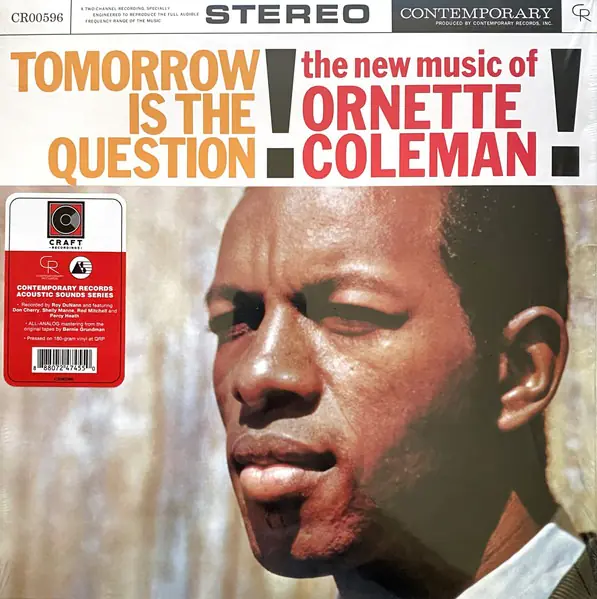
Ornette Coleman – Tomorrow Is The Question! – 18- Gram Vinyl Record
Ornette Coleman – Tomorrow Is the Question! (1959) is one of the most pivotal albums in the history of modern jazz—not just for what it sounds like, but for what it refused to be. Released on the Contemporary Records label and produced by Lester Koenig, it was Coleman’s second studio album, recorded just months before his legendary Atlantic debut The Shape of Jazz to Come (1959). But in many ways, Tomorrow Is the Question! is the real turning point: the place where Coleman fully begins to unshackle himself from the constraints of bebop harmony and set the stage for what would become known as free jazz.
This was the first album where Coleman chose to forgo a chordal instrument—there’s no piano here—making it one of the earliest mainstream jazz records to do so. That decision alone was revolutionary. In bebop and hard bop, the piano (or guitar) typically served as the harmonic anchor, outlining chord changes and establishing form. By removing it, Coleman created harmonic ambiguity and openness, allowing his alto saxophone lines to explore melody with far greater freedom. He could float, dart, and bend notes without having to “fit” them into traditional changes. It was a sonic rejection of rigidity and an embrace of intuition, conversation, and pure melodic logic.
The album features two separate rhythm sections: on some tracks, Don Cherry (trumpet), Percy Heath (bass), and Shelly Manne (drums); on others, Cherry is joined by Red Mitchell (bass) and Billy Higgins (drums). Though both lineups serve Coleman’s concept well, the presence of Cherry—his musical soulmate—gives the music a sense of spontaneous interplay that would later blossom fully in their Atlantic recordings. Their frontline dialogues on this album are playful, searching, and charged with tension, as if both players are constantly discovering and reacting in real time.
Tracks like “Tomorrow Is the Question!”, “Mind and Time,” and “Rejoicing” feel completely untethered to traditional harmonic development. Instead, Coleman’s approach centers around motivic development and melodic phrasing—he isn’t thinking about solos as trips through chord progressions but as melodic ideas being worked out communally in the moment. This opens the door to what would soon become the core of the free jazz ethos: not freedom from structure entirely, but freedom within and from preordained harmonic expectations.
Yet the music here is not chaotic. Far from it. It’s lyrical, inquisitive, and soulful, often with a blues core that grounds its emotional weight. Coleman’s phrasing draws on speech, on gospel, on folk melodies—infusing each piece with a directness and vulnerability that made some listeners uncomfortable and others ecstatic. His tone on alto is raw, keening, nasal, and completely his own—described by critics at the time as “out of tune,” but more accurately it was out of conformity. There’s also a joyful urgency to the playing. Coleman’s music never feels academic or abstracted. It feels alive, like a street sermon or a child’s wildly imaginative story—full of emotion, rhythm, and deep insight.
It’s worth noting that Tomorrow Is the Question! was met with confusion and skepticism in many jazz circles upon release. Some critics admired its boldness; others thought Coleman simply didn’t know how to play “correctly.” But his ideas weren’t naïve—they were radically intentional. By eliminating the piano and emphasizing collective improvisation, Coleman was moving toward a music that was less about harmonic compliance and more about personal expression, a kind of musical democracy. Every player had more room to speak, and the dialogue became the song.
The album ends with “The Blessing”, a tune that is both swinging and unorthodox, with its singable head melody and unpredictable turns. It’s one of many examples where Coleman proves that breaking the rules doesn’t mean abandoning melody—it means redefining where melody begins and how it moves.
In hindsight, Tomorrow Is the Question! stands as a bold transitional document, a moment when the old jazz world still lingered just barely in the rearview mirror, and the avant-garde was just around the bend. It prefigures The Shape of Jazz to Come but holds a distinct place of its own—more intimate, more questioning, perhaps even more radical in its subtlety. It’s not just Ornette telling us the future of jazz is arriving—it’s him asking us to participate in imagining it.
Brand new, never played and still sealed in the factory plastic
Track Listing
Tomorrow Is The Question!
Tears Inside
Mind And Time
Compassion
Giggin’
Rejoicing
Lorraine
Turnaround
Endless