Description
Saul Williams – Saul Williams – Galaxy Blue Vinyl Record
Vinyl Me, Please
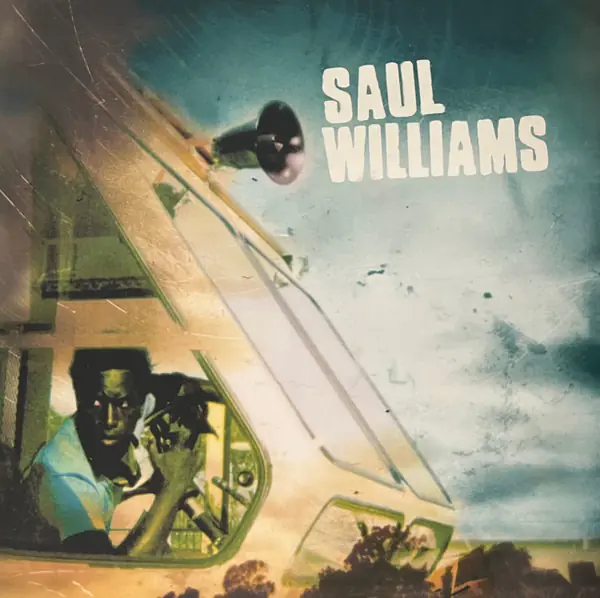
Saul Williams’ 2004 self-titled, sophomore album is making its vinyl debut exclusively at VMP. Featuring additional talent from System of a Down’s Serj Tankian, Rage Against the Machine’s Zack de la Rocha and Isaiah Owens, and the massive song “List of Demands (Reparations),” Saul Williams laid the groundwork for how artists could approach the eclectic fusion of spoken word and electro-rap.
The first-ever vinyl release of Saul Williams’ Saul Williams is pressed on Galaxy Blue vinyl at Precision Record Pressing (PRP).
Saul Williams – Saul Williams (2004) is a landmark album that fuses hip-hop, punk, industrial rock, spoken word, and Afrofuturist poetics into a bold and confrontational artistic manifesto. As the eponymous title suggests, this record serves as both a personal statement and a political declaration, crystallizing the identity of an artist who defies categorization. Williams, already known by this time as a celebrated poet, actor, and performer (following his 2001 debut Amethyst Rock Star and appearances in Slam), uses this sophomore album to fully bridge the gap between poetry and music, not just as forms of expression, but as tools of resistance, reckoning, and spiritual elevation.
The sound of Saul Williams is abrasive and defiant. Co-produced by Williams and Rick Rubin, the album thrives on raw energy and industrial textures, incorporating distorted guitars, metallic percussion, and heavy beats that nod to Nine Inch Nails and Public Enemy in equal measure. But where many albums use sonic aggression for shock value, Williams uses it with intention and depth, often contrasting it with quiet, almost meditative moments of spoken word reflection. The album is not an easy listen, nor is it meant to be. It demands engagement—intellectually, emotionally, politically—inviting listeners into a world where spiritual warfare and cultural critique go hand in hand.
From the opening track, “Talk to Strangers,” Williams sets the tone with a poem rather than a song, immediately asserting that language—not melody—will be his primary weapon. His voice is steady, solemn, and purposeful, laying the groundwork for what follows. The next track, “Grippo,” dives headfirst into pounding rhythms and metallic beats, with Williams unleashing a torrent of rhymes that challenge capitalist structures, racial injustice, and spiritual complacency. His lyrical delivery oscillates between rap and invocation, blending urgency with philosophical inquiry. The album’s centerpiece, “List of Demands (Reparations),” is a furious anthem built around a throbbing, minimalist groove and a shouted refrain: “I want my money back / I want my money back!” It’s both a literal cry for reparations and a metaphor for reclaiming stolen identity, agency, and truth. The song later found renewed life when it was covered by TV on the Radio in 2018, but the original version remains visceral and iconic.
Another standout, “Black Stacey,” is perhaps the album’s most autobiographical track. Over a sparse, pulsing beat, Williams recounts his childhood experiences with colorism, identity, and self-perception. The line “Now I’m Black Stacey / They call me Black Stacey / I never got to be myself / ‘Cause to myself I always was Black Stacey” reflects a profound tension between internalized shame and cultural pride, eventually leading to a moment of radical self-acceptance. It’s one of the most vulnerable and human moments on an otherwise electrifying and confrontational record. That duality—vulnerability and rage, intellect and emotion—is what gives the album its lasting power.
Throughout Saul Williams, the artist moves fluidly between the spiritual and the political, the personal and the collective. Songs like “PG” and “African Student Movement” critique systemic oppression and offer alternatives through self-knowledge, myth, and resistance. “Notice of Eviction” is a spoken-word piece delivered with apocalyptic calm, full of biblical cadence and mythopoetic metaphor. “Act III Scene 2 (Shakespeare)”, another highlight, draws on high literature and black vernacular tradition simultaneously, collapsing distinctions between so-called “high” and “low” art. For Williams, all language is sacred—and all language is political.
Musically, the album’s use of rock and industrial elements distinguishes it from most hip-hop of its era. It emerged during a time when mainstream rap was dominated by the bling era, club anthems, and commercial polish. Saul Williams stood in stark contrast—a declaration of artistic and spiritual war against mediocrity and conformity. It sits comfortably alongside other genre-defying records like Tricky’s Pre-Millennium Tension, Nine Inch Nails’ The Fragile, and Public Enemy’s Fear of a Black Planet, while also anticipating the emergence of politically charged, genre-blending artists like Kendrick Lamar, Death Grips, and clipping.
Ultimately, Saul Williams is an album of radical intent. It doesn’t aim to entertain—it aims to awaken, to unsettle, to provoke. It’s a record that treats music not just as rhythm and sound, but as ritual, protest, prophecy, and prayer. It invites repeated listens because it doesn’t give up all its meanings at once. Like the best political art, it continues to resonate because it speaks from a place of truth that is as personal as it is universal.
Brand new, never played and still sealed in the factory plastic
Track Listing
Talk To Strangers
Grippo
Telegram
Act III Scene 2 [Shakespeare]
List Of Demands [Reparations]
African Student Movement
Black Stacey
PG
Surrender [A Second To Think]
BControl Freak
Seaweed
Notice Of Eviction