Description
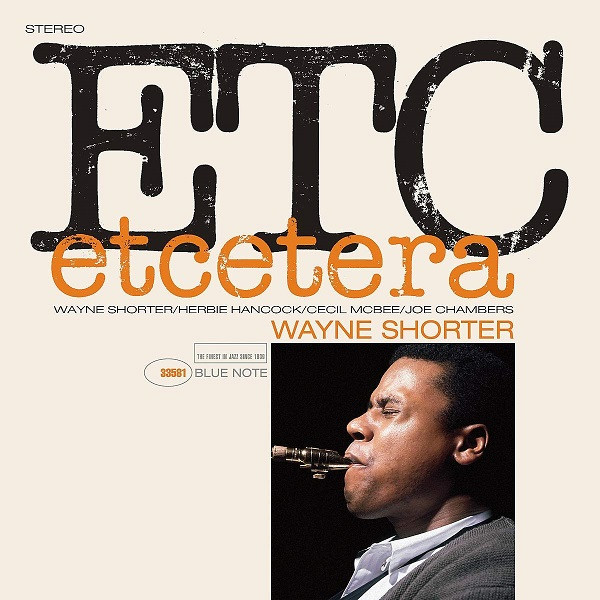
Wayne Shorter – Etcetera – 180 Gram Vinyl Record
A Hidden Gem from Blue Note’s Golden Era
Few artists in jazz have combined lyricism, imagination, and compositional daring like Wayne Shorter. Recorded on June 14, 1965, at Rudy Van Gelder’s famed New Jersey studio for Blue Note Records, Etcetera remained in the vaults for 15 years before its eventual release in 1980. As a result, this remarkable session is often overlooked in discussions of Shorter’s classic mid-1960s output. Yet those who seek it out are rewarded with one of his most intimate, understated, and quietly brilliant albums—a record that captures Shorter at the height of his creativity.
The quartet on Etcetera is stellar:
Wayne Shorter – tenor saxophone
Herbie Hancock – piano
Cecil McBee – bass
Joe Chambers – drums
This lineup is a testament to Shorter’s connections to the era’s most forward-thinking players. Hancock was already Shorter’s colleague in the Miles Davis Quintet, McBee was an emerging bassist with a strong grounding in both tradition and avant-garde, and Chambers was one of Blue Note’s most inventive and sensitive drummers. Together, they create a flexible, conversational atmosphere perfectly suited to Shorter’s writing.
The album contains five tracks, all distinctive in mood and texture:
“Etcetera” – The title track opens the album with a gentle, meditative melody. It’s lyrical and patient, setting a contemplative tone that feels closer to chamber music than fiery hard bop. Hancock’s understated accompaniment and Chambers’s delicate brushwork create a floating backdrop for Shorter’s expressive tenor lines.
“Penelope” – One of the album’s most beautiful ballads, “Penelope” is a showcase for Shorter’s gift for melody. His tenor sound here is tender yet probing, while Hancock’s sparse voicings give the piece a timeless, almost impressionistic quality.
“Toy Tune” – The most playful track, with a quirky, almost childlike theme that reveals Shorter’s sense of humor and whimsy. The tune shifts between lighthearted swing and subtle harmonic twists, exemplifying Shorter’s talent for blending accessibility with abstraction.
“Barracudas (General Assembly)” – The album’s most rhythmically driven piece, full of energy and propulsion. McBee and Chambers lock into a pulsing groove while Shorter stretches over the top with angular lines. It’s adventurous but still firmly rooted in hard bop tradition.
“Indian Song” – The closing track is a spacious, modal exploration, meditative and trance-like. Its open-ended structure anticipates some of the freer explorations Shorter would pursue later in the decade, while still anchored by melody.
What makes Etcetera so special is its restraint and subtlety. Unlike some of Shorter’s more dramatic albums from the same period (JuJu, Speak No Evil, The All Seeing Eye), this record favors intimacy over intensity. It feels like a private conversation between master musicians, unhurried and deeply attuned to each other.
Because it was not released until 1980, Etcetera never gained the same canonical status as Shorter’s other Blue Note albums of the mid-1960s. Yet many listeners who discover it later in his catalog find it one of his most rewarding. It captures a softer, more lyrical side of Shorter’s artistry, complementing the bold innovations of his more famous sessions.
Etcetera is a hidden treasure in Wayne Shorter’s discography, proof that even his “lost” sessions are masterworks. It highlights his range as a composer and saxophonist, his ability to balance simplicity and sophistication, and his unmatched chemistry with Herbie Hancock. For fans of Blue Note’s golden era—and for anyone seeking the quieter, more contemplative side of jazz—Etcetera is essential listening.
Brand new, never played and still sealed in the factory plastic
Track Listing
Etcetera
Penelope
Toy Tune
Barracudas (General Assembly)
Indian Song