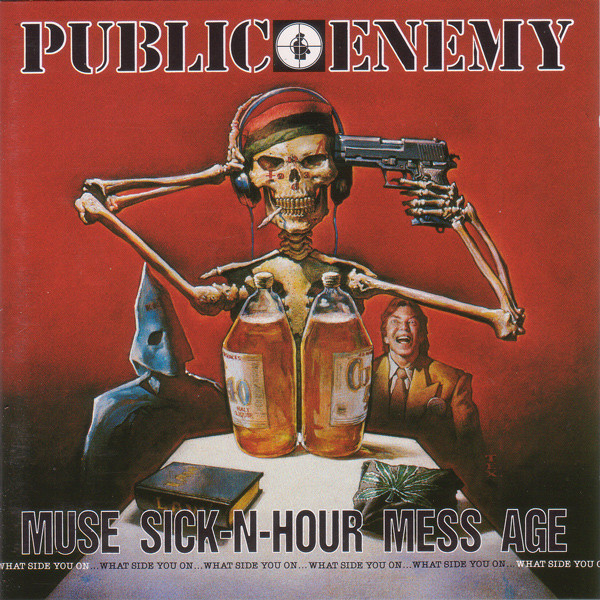
Description
Public Enemy – Muse Sick-N-Hour Mess Age – Compact Disc
Public Enemy – Muse Sick-N-Hour Mess Age, released on August 23, 1994, is one of the most misunderstood and underrated albums in Public Enemy’s discography. Arriving after the critical and commercial highs of It Takes a Nation of Millions to Hold Us Back (1988), Fear of a Black Planet (1990), and Apocalypse 91… The Enemy Strikes Black (1991), this album came during a time of massive change in the hip-hop landscape—when gangsta rap and G-funk were dominating airwaves, and political rap was starting to be seen by the mainstream as passé. As a result, Muse Sick-N-Hour Mess Age was met with confusion and even dismissal by some critics at the time, but in hindsight, it’s a fierce, layered, and defiant album that still hits with biting insight.
The album title itself—a phonetic play on “Music and Our Message” and “Music in Our Message”—reveals its central tension. Chuck D and crew are deeply concerned with how hip-hop’s cultural power was being diluted in the early ‘90s by commercialism, violence, and sensationalism. This album, then, is part protest, part call to arms, and part warning. But it’s not just a lecture—it’s wrapped in booming beats, funk-laced grooves, and lyrical venom, staying true to the sonic identity of Public Enemy while adjusting to the musical climate of the mid-’90s.
From the jump, Muse Sick-N-Hour Mess Age makes its intentions clear with the track “Whole Lotta Love Goin On in the Middle of Hell”—a dense, funky opener that combines a celebration of Black resilience with warnings about social and industry decay. Chuck D’s voice is as powerful as ever—deep, commanding, and full of controlled fury—while Flavor Flav brings his usual chaotic energy and streetwise humor.
One of the most pointed tracks is “Give It Up,” the lead single, which critiques the radio and record industry’s focus on gangster clichés while riding a funky, accessible groove that stands in contrast to its rebellious message. It’s Public Enemy at their best: catchy and confrontational at the same time. The hook is ironic (“Give it up, that’s what we’re gonna do”), but the song is a refusal—a refusal to give up integrity in exchange for marketability.
Elsewhere, “What Kind of Power We Got?” blends scratching and slamming beats with Chuck D’s analysis of systemic oppression, while “So Whatcha Gonna Do Now?” directly challenges artists who had abandoned community and consciousness in favor of materialism and shock value. There’s also a heavy focus on internal critiques within the Black community, reflecting Chuck D’s belief in holding one’s own accountable while still resisting broader systems of inequality.
Muse Sick is less sonically radical than the dense, sample-layered chaos of Nation of Millions, but it still boasts a tight production style courtesy of Gary G-Wiz and others in the Bomb Squad, with grooves that draw from funk, soul, rock, and classic P.E. dissonance. The production feels more organic, less sample-heavy due to legal changes in sampling laws, but still maintains the group’s signature agitated energy. The album is long and sprawling (21 tracks, over 70 minutes), which can be overwhelming, but it’s a deliberate choice—this is a full manifesto, not a collection of singles.
Importantly, Muse Sick-N-Hour Mess Age was also a response to criticisms that Public Enemy was out of touch in the gangsta era. Chuck D fires back at this narrative on “I Stand Accused,” attacking the idea that Black political music was no longer relevant, arguing instead that the industry was actively marginalizing conscious voices. This idea would later be echoed by artists like Dead Prez and Mos Def in the late ’90s and early 2000s.
Despite its thematic and musical strengths, the album suffered from critical backlash at the time of release. Notably, The Source magazine ran a negative review before the album was even released, citing irrelevance in the age of Death Row and Bad Boy dominance. This perception deeply frustrated Chuck D, who viewed the review as emblematic of a larger industry shift away from accountability and substance.
In retrospect, however, Muse Sick-N-Hour Mess Age has aged far better than many of its critics predicted. It’s now appreciated by many fans and scholars as a resolute, necessary album, one that may have been out of step with commercial trends but completely in step with the moral urgency and activist DNA of hip-hop. It’s a record of resistance in a time of transition, a stubborn act of truth-telling when selling out seemed easier.
If you’re exploring the album today, don’t expect the sharp immediacy of Nation of Millions—instead, take it as a complex, angry, sprawling document of a group trying to stay principled in a shifting musical and cultural landscape. It’s as relevant now as it was then, especially in its critiques of media narratives, cultural commodification, and the silencing of radical Black voices.
Brand new, never played and still sealed in the factory plastic
Track Listing
Whole Lotta Love Goin On In The Middle Of Hell
Theatrical Parts
Give It Up
What Side You On?
Bedlam 13:13
Stop In The Name…
What Kind Of Power We Got?
So Whatcha Gone Do Now?
White Heaven / Black Hell
Race Against Time
They Used To Call It Dope
Aintnuttin Buttersong
Live And Undrugged Pt. 1 & 2
Thin Line Between Law & Rape
I Ain’t Mad At All
Death Of A Carjacka
I Stand Accused
Godd Complexx
Hitler Day
Harry Allen’s Interactive Super Highway Phone Call To Chuck D
Living In A Zoo (Remix)