Description
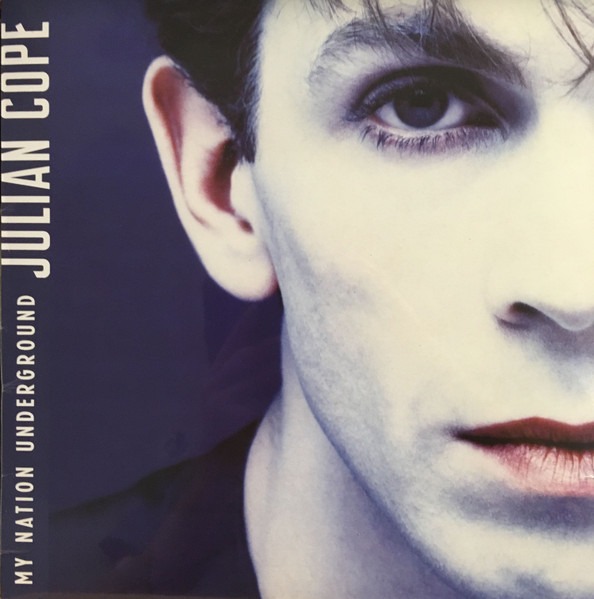
Julian Cope – My Nation Underground – Vinyl Record
My Nation Underground is the third solo album by Julian Cope, released in 1988. It occupies a fascinating place in Cope’s discography: his most commercially oriented album, yet one that still bears the stamp of his eccentric imagination. Blending alternative rock, neo-psychedelia, post-punk, pop rock, and college rock, the album captures an artist caught between major-label expectations and his own increasingly adventurous creative instincts.
Following the critical success of Saint Julian, Cope found himself under pressure to deliver another commercially successful record. While My Nation Underground contains some of his most accessible songs, it also reveals an artist growing restless with conventional rock structures—a tension that would soon lead him toward the more experimental work of Skellington and Peggy Suicide.
The production is polished by Cope’s standards, reflecting late-1980s studio aesthetics without entirely smoothing away his quirky personality. Layered guitars, keyboards, melodic bass lines, and crisp drums create a bright, expansive sound that contrasts with the rawer feel of some of his earlier and later recordings.
The album’s best-known song, “Charlotte Anne,” became one of Cope’s biggest international hits. Its infectious melody, chiming guitars, and memorable chorus demonstrate his gift for crafting intelligent, literate pop songs while retaining a slightly off-center perspective that distinguishes him from more conventional rock artists.
Cope’s vocal style remains one of his defining characteristics. Rather than relying on technical virtuosity, he sings with charisma, wit, and emotional immediacy. His expressive delivery moves easily between irony, vulnerability, enthusiasm, and introspection, giving the album a distinctly personal character.
Lyrically, My Nation Underground explores themes of identity, politics, spirituality, modern society, relationships, and self-awareness. Even at his most accessible, Cope avoids straightforward narratives, preferring surreal imagery, historical references, and symbolic language that invite multiple interpretations.
The guitar work balances shimmering pop textures with psychedelic flourishes, while keyboards add atmosphere without dominating the arrangements. The rhythm section provides steady, melodic support, allowing Cope’s songs to remain firmly in the foreground.
One of the album’s most interesting qualities is the contrast between its accessible musical surface and its often unconventional lyrical content. While many of the songs are immediately catchy, repeated listening reveals layers of philosophical reflection, satire, and cultural commentary beneath their melodic appeal.
Upon its release, My Nation Underground received mixed reviews. Many critics admired the songwriting and singled out “Charlotte Anne,” but some felt the polished production restrained Cope’s more adventurous instincts. Cope himself later expressed dissatisfaction with the album, believing that major-label pressures had pushed him toward a more commercial direction than he preferred.
In retrospect, however, the album has been reassessed more favorably. Many listeners now appreciate it as an intriguing transitional work that combines Cope’s melodic strengths with hints of the fearless experimentation that would define his later career. It demonstrates that even within commercial constraints, his singular artistic voice remained unmistakable.
What makes My Nation Underground especially rewarding is its balance between accessibility and individuality. It is perhaps the easiest entry point into Julian Cope’s solo catalog, yet it still contains enough eccentricity and intellectual curiosity to satisfy longtime fans.
With its memorable melodies, thoughtful songwriting, and distinctive blend of pop craftsmanship and psychedelic imagination, My Nation Underground remains one of Julian Cope’s most engaging albums. Though often overshadowed by both Saint Julian and his more radical later work, it captures a gifted songwriter navigating the space between mainstream success and uncompromising artistic expression. Rich in hooks, ideas, and personality, it continues to stand as an underrated chapter in the career of one of British rock’s most original voices.
Brand new, never played and still sealed in the factory plastic
Track Listing
5 O’Clock World
Vegetation
Charlotte Anne
My Nation Underground
China Doll
Someone Like Me
Easter Everywhere
I’m Not Losing Sleep
The Great White Hoax