Description
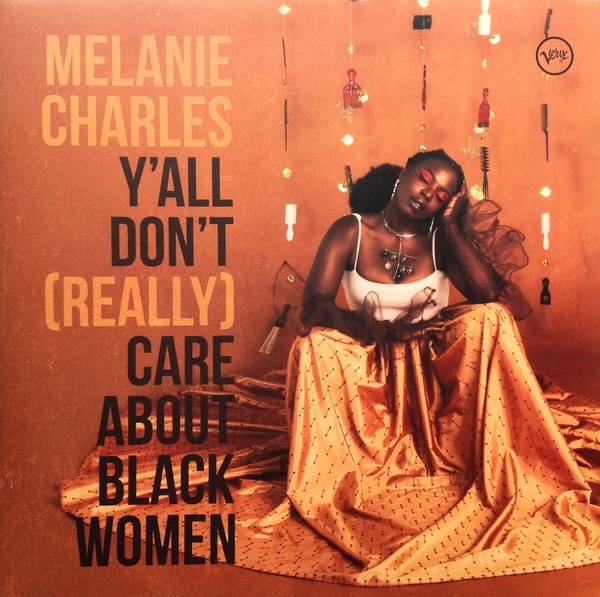
Melanie Charles – Y’all Don’t (Really) Care About Black Women – 180 Gram Vinyl Record
Y’all Don’t (Really) Care About Black Women is a powerful and uncompromising album by Melanie Charles, released in 2021 as a bold artistic statement addressing race, gender, visibility, identity, and social justice through the lens of Black womanhood. Blending jazz, soul, hip-hop, R&B, spoken word, electronic music, and Afro-diasporic influences, the album is both a personal expression and a broader cultural critique, showcasing Charles’ ability to combine musical innovation with urgent social commentary.
Born to Haitian parents and raised in Brooklyn, Melanie Charles has built a reputation as one of the most adventurous artists in contemporary creative music. A vocalist, instrumentalist, producer, and composer, she moves fluidly between genres while drawing upon jazz traditions, Black musical history, and modern production techniques. On Y’all Don’t (Really) Care About Black Women, she brings these influences together to create a work that is intellectually provocative, emotionally resonant, and musically inventive.
The album’s title immediately signals its central concern. It references a long history of Black women being overlooked, marginalized, exploited, or excluded from conversations about justice, equality, and representation. Rather than presenting these issues in purely academic terms, Charles explores them through lived experience, personal reflection, and artistic expression. The result is a work that feels both deeply individual and broadly relevant.
One of the album’s defining strengths is its refusal to separate politics from everyday life. Charles examines how systemic inequalities affect personal relationships, mental health, self-image, artistic opportunities, and cultural recognition. The songs address these realities with honesty and complexity, avoiding simplistic narratives while maintaining a clear sense of purpose. Throughout the album, she challenges listeners to consider whose voices are heard, whose experiences are valued, and whose contributions are often overlooked.
Musically, the record is remarkably diverse. Jazz improvisation, soul grooves, hip-hop rhythms, electronic textures, and spoken-word passages coexist within a cohesive artistic framework. Charles’ background as both a jazz musician and contemporary producer allows her to move seamlessly between traditions, creating a sound that feels rooted in Black musical history while remaining distinctly modern. This genre-fluid approach reflects the album’s broader themes of resisting limitation and embracing multiplicity.
Vocally, Charles delivers performances that are expressive, versatile, and emotionally direct. She moves effortlessly between singing, spoken word, and more conversational forms of delivery, using each approach to serve the needs of the material. Her voice conveys frustration, resilience, vulnerability, humor, and determination, often within the same piece. This emotional range helps make the album feel dynamic and deeply human.
A significant aspect of the project is its engagement with jazz history. Charles has long been interested in highlighting the contributions of Black women to jazz and creative music, and that commitment is evident throughout the album. By drawing on traditions established by earlier generations while asserting her own artistic voice, she situates herself within a broader continuum of Black women musicians who have shaped American culture despite often receiving insufficient recognition.
The album’s production is equally noteworthy. Charles combines live instrumentation with contemporary studio techniques, creating layered soundscapes that support both the music and the message. Flute, keyboards, electronic elements, rhythm tracks, and vocal textures interact in creative ways, resulting in a sonic environment that feels immersive and constantly evolving. The production reflects her strengths not only as a performer but also as a visionary musical architect.
Another important dimension of the album is its balance between critique and affirmation. While the title and themes address serious injustices, the music is not solely focused on anger or protest. Moments of joy, celebration, self-love, and cultural pride appear throughout the record, emphasizing the resilience and creativity of Black women rather than reducing them to narratives of struggle alone. This balance gives the album emotional depth and complexity.
Upon its release, Y’all Don’t (Really) Care About Black Women received praise for its originality, courage, and artistic ambition. Critics highlighted Charles’ ability to merge social commentary with adventurous musicianship, noting how effectively the album challenged listeners while remaining engaging as a musical experience. Many viewed it as an important contribution to contemporary jazz and creative music, as well as a significant cultural statement.
The album also reflects broader developments within modern jazz and experimental music, where artists increasingly use their work to address questions of identity, history, and social justice. Charles demonstrates that these themes can be explored without sacrificing musical sophistication, creating a project that is as artistically compelling as it is politically meaningful.
With its innovative sound, fearless perspective, and emotional honesty, Y’all Don’t (Really) Care About Black Women stands as one of Melanie Charles’ most important achievements. The album combines personal storytelling, cultural critique, and musical exploration into a unified artistic vision that challenges, inspires, and resonates. Bold, intelligent, and deeply affecting, it is a powerful testament to the enduring role of music as a vehicle for truth, resistance, and self-expression.
Brand new, never played and still sealed in the factory plastic
Track Listing
God Bless The Child
Perdido (Reimagined)
Detour Ahead (Reimagined)
All Africa (The Beat)
Pay Black Women Interlude
Woman Of The Ghetto (Reimagined)
The Music Is The Magic
Jazz (Ain’t Nothing But Soul) (Reimagined)
Go Away, Little Boy
What A Difference (Reimagined)
Beginning To See The Light (Reimagined)