Description
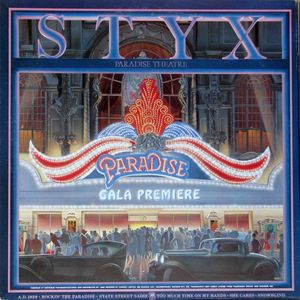
Styx – Paradise Theatre – Vinyl Record
Styx – Paradise Theatre is one of the band’s most celebrated albums, released on January 16, 1981 through A&M Records. It was Styx’s 10th studio album and their only #1 on the Billboard 200, where it stayed at the top for three weeks. A concept album in spirit, it uses the rise and fall of Chicago’s historic Paradise Theatre (which opened in 1928 and was demolished in 1956) as a metaphor for the optimism and eventual decline of the American dream in the 20th century.
The album blends Styx’s hallmark mix of progressive rock, hard rock, and pop balladry, with lush production and theatrical flair. Keyboardist and vocalist Dennis DeYoung was the driving force behind the album’s concept, while guitarists Tommy Shaw and James “J.Y.” Young contributed key songs that added grit and balance to DeYoung’s more polished, Broadway-influenced sensibilities. This tension between rock swagger and theatrical ambition is part of what makes Paradise Theatre such a compelling record.
The opening track, “A.D. 1928 / Rockin’ the Paradise,” sets the tone, with DeYoung’s reflective piano giving way to a rousing anthem about unity and renewal. Shaw’s “Too Much Time on My Hands” became one of the band’s biggest hits, driven by its unforgettable synth riff and sardonic lyrics about boredom and self-destruction—it remains a staple on classic rock radio. DeYoung’s “The Best of Times” was another standout, a heartfelt ballad that reached #3 on the Billboard Hot 100, showcasing his gift for soaring melodies and earnest emotion.
Elsewhere, the album balances its grand themes with stylistic variety. Young’s “Snowblind” is a heavy, ominous rocker that tackles drug addiction (later controversially accused of backmasking “Satanic” messages). DeYoung’s “Nothing Ever Goes As Planned” adds a cabaret-like flair, while Shaw’s “She Cares” offers a tender, understated ballad. The closing sequence, “Half-Penny, Two-Penny” and “A.D. 1958,” ties the concept together, depicting the decline of both the Paradise Theatre and broader social optimism, ending with a mournful reprise of the opening theme.
The album speaks to themes of decay, disillusionment, and hope, reflecting anxieties about America at the dawn of the 1980s—urban decline, cultural fragmentation, and the search for meaning in uncertain times. Yet it’s not a bleak record; songs like “Rockin’ the Paradise” and “The Best of Times” embody resilience and optimism in the face of change.
Paradise Theatre was praised for its ambition and accessibility, and it became Styx’s most commercially successful album, selling over 3 million copies in the U.S. Its blend of progressive rock elements with arena-ready hooks placed it at the heart of early ’80s AOR (album-oriented rock). However, it also deepened the internal stylistic divide within the band—between DeYoung’s theatrical vision and Shaw/Young’s rock instincts—which would eventually lead to creative clashes.
Today, Paradise Theatre is often considered Styx’s crowning achievement: a record that balances concept, hit singles, and instrumental prowess. It captures the band at the peak of their popularity, fusing progressive ambition with mainstream appeal, while also serving as a time capsule of early ’80s rock culture.
Brand new, never played and still sealed in the factory plastic
Track Listing
A.D. 1928
Rockin’ The Paradise
Too Much Time On My Hands
Nothing Ever Goes As Planned
The Best Of Times
Lonely People
She Cares
Snowblind
Half-Penny, Two-Penny
A.D. 1958
State Street Sadie