Description
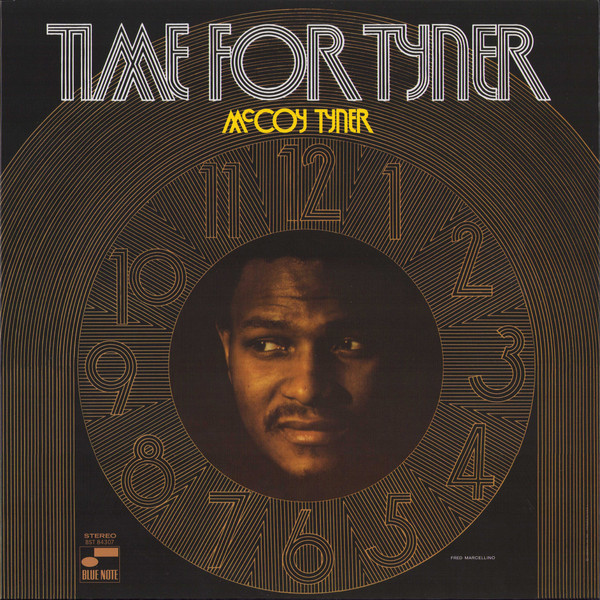
McCoy Tyner – Time For Tyner – 180 Gram Vinyl Record
Time for Tyner, recorded in May 1968 and released in 1969 on Blue Note Records, is a striking and often underrated entry in the expansive catalog of pianist McCoy Tyner. Best known as the powerhouse pianist of the John Coltrane Quartet during the early to mid-1960s, Tyner had by this point firmly stepped into his own as a solo artist. Time for Tyner is a compelling transitional record—it captures Tyner between the modal firestorms of his work with Coltrane and the more expansive, world music–infused albums of his 1970s Milestone period. It’s a concise yet deeply expressive album, where Tyner explores jazz tradition through his evolving personal lens, combining lyricism, rhythmic force, and harmonic richness.
The lineup on the album is small but mighty. Tyner leads a quartet featuring Bobby Hutcherson on vibraphone, Herbie Lewis on bass, and Freddie Waits on drums. The pairing of piano and vibes gives the album a unique sonic texture—cool and resonant, with a floating, almost glassy elegance. Tyner and Hutcherson are a particularly inspired match. While Tyner’s playing is grounded in percussive strength and modal density, Hutcherson brings a shimmering lyricism that lifts the music into ethereal territory. Their interaction is intimate and intuitive, often moving in parallel phrases or complementary counterpoint that feels conversational rather than competitive.
The album opens with “African Village,” an original composition that immediately sets a meditative and subtly polyrhythmic tone. Built on a modal vamp, it reflects Tyner’s growing interest in African rhythmic forms and spiritual themes, ideas that would later dominate albums like Sahara and Extensions. His left hand lays down a powerful, repeating motif while his right hand dances across modes, creating tension and resolution in waves. Hutcherson echoes and expands on these ideas, and the rhythm section maintains a steady undercurrent, simultaneously rooted and flowing.
From there, the album moves into more traditional territory, but always with Tyner’s distinct harmonic voice. His renditions of “Little Madimba” and “May Street” are infused with rhythmic propulsion and elegant chordal movement, balancing swing with structural complexity. There’s a clear post-bop vocabulary at work, but Tyner’s use of quartal harmonies and pedal points—hallmarks of his style—pulls the music into a more open and expansive space.
The second half of the album is more reflective. Tyner’s solo interpretation of “I Didn’t Know What Time It Was” is a highlight: lyrical, harmonically rich, and full of personal inflection. He’s not simply reharmonizing the standard but reimagining its emotional landscape. The clarity of his touch and the thoughtfulness of his pacing reveal just how deeply he understood the piano as both a rhythmic and melodic instrument. “The Surrey with the Fringe on Top” is treated with playful syncopation and creative phrasing, transforming the Rodgers and Hammerstein tune into a canvas for intricate improvisation. The closer, “I’ve Grown Accustomed to Her Face,” is another solo piece—gentle, impressionistic, and wistful. It ends the album not with fireworks but with tenderness and restraint.
Time for Tyner is notable for its balance between tradition and innovation. It doesn’t push as far into the avant-garde as some of Tyner’s peers did in the late ’60s, but it doesn’t cling to hard bop conventions either. Instead, it quietly expands the vocabulary of modal jazz, driven by Tyner’s growing sense of spiritual and cultural exploration. The album’s compact length (just over 35 minutes) makes it feel almost like a suite—focused, coherent, and emotionally resonant from beginning to end.
While it may not be as widely cited as The Real McCoy (1967) or Sahara (1972), Time for Tyner remains one of McCoy Tyner’s most beautifully crafted and accessible albums. It’s a perfect entry point for listeners looking to explore his post-Coltrane work, and a rewarding listen for anyone interested in the deep intersection of melody, rhythm, and modal harmony in acoustic jazz. It’s not just “time for Tyner”—it’s a moment of quiet brilliance in a career full of towering achievements.
Cut directly from the original analog tapes
Recorded By Rudy Van Gelder
Reissue Supervised by Joe Harley
Mastered by Kevin Gray at Cohearent Audio
Manufactured at Record Technology Inc. (RTI) on 180 gram vinyl
Brand new, never played and still sealed in the factory plastic
Track Listing
African Village
Little Madimba
May Street
I Didn’t Know What Time It Was
The Surrey With The Fringe On Top
I’ve Grown Accustomed To Her Face