Description
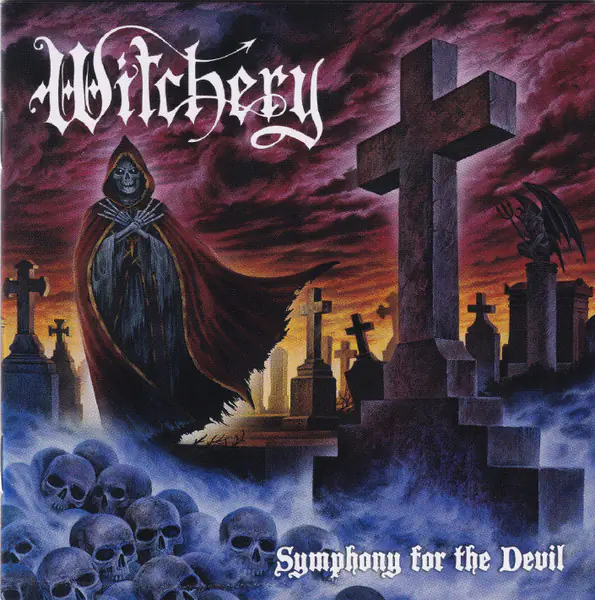
Witchery – Symphony For The Devil – Vinyl Record
From its opening moments, Symphony for the Devil makes one thing perfectly clear: Witchery has no interest in subtlety. Released in 2001, the album barrels forward with the confidence of a band that knows exactly what kind of ride it’s offering. Equal parts thrash metal, melodic death metal, blackened heavy metal, and horror soundtrack, it’s less a descent into darkness than a gleeful sprint through a haunted house built by musicians with an encyclopedic knowledge of classic metal.
What separates Witchery from many of their contemporaries is their sense of fun. The lyrics revel in tales of the occult, supernatural horror, and slasher-film mayhem, but there’s always a knowing grin behind the menace. Rather than striving for philosophical darkness or existential despair, the band embraces the theatrical traditions of artists like Mercyful Fate and early Venom, where horror is as much entertainment as intimidation.
The musicianship, however, is anything but tongue-in-cheek. Guitarists Jensen and Rickard Rimfält keep the riffs coming at a relentless pace, balancing razor-sharp thrash attack with melodic flourishes that betray the band’s Swedish roots. The songs rarely overstay their welcome. Instead, they hit hard, deliver memorable hooks, unleash a blistering solo or two, and move on before the momentum has a chance to fade.
Behind the kit, Martin Axenrot—who would later gain worldwide recognition with Opeth—plays with remarkable precision. His performance is a constant reminder that speed alone isn’t enough; every blast beat, double-kick run, and cymbal accent serves the song rather than simply demonstrating endurance. The rhythm section keeps the music grounded even as the guitars threaten to spiral into controlled chaos.
Vocalist Toxine delivers a performance that sits comfortably between a death-metal growl and a venomous thrash bark. His voice isn’t designed to dominate the mix through sheer brutality. Instead, it becomes another weapon in the band’s arsenal, adding texture and attitude without overwhelming the riffs that remain the true stars of the record.
One of the album’s greatest strengths is its pacing. At just over forty minutes, Symphony for the Devil understands that intensity is most effective when it doesn’t become exhausting. The band mixes full-throttle assaults with slower, groove-oriented passages and eerie melodic interludes, allowing each burst of aggression to retain its impact. There’s very little filler here—just a succession of tightly constructed songs that know exactly what they’re trying to accomplish.
The production strikes a satisfying middle ground between clarity and grit. Every instrument cuts through the mix, but nothing feels overly polished. The guitars retain enough rough edges to preserve the album’s underground spirit, while the drums and bass provide plenty of punch. More than two decades later, the record still sounds muscular without feeling trapped by early-2000s production trends.
Looking back, Symphony for the Devil arrived during a fertile period for Scandinavian extreme metal, yet it deliberately occupied its own niche. While many bands were becoming increasingly technical or atmospheric, Witchery remained committed to writing memorable songs fueled by classic metal instincts. Their affection for the genre’s history is obvious, but it never comes across as nostalgia. Instead, they treat those influences as raw materials for something energetic and distinctly their own.
Perhaps that’s why the album continues to hold up so well. It doesn’t pretend to be revolutionary, nor does it chase whatever was fashionable at the time. It simply delivers a confident blend of speed, melody, horror, and swagger with remarkable consistency.
Symphony for the Devil is the kind of metal album that reminds you why riffs matter. It’s fast without becoming mechanical, dark without taking itself too seriously, and technically impressive without sacrificing excitement. More than twenty years after its release, it remains one of Witchery’s strongest statements—a celebration of heavy metal’s ability to be thrilling, theatrical, and unapologetically loud all at once.
Brand new, never played and still sealed in the factory plastic
Track Listing
The Storm
Unholy Wars
Inquisition
Omens
Bone Mill
None Buried Deeper…
Wicked
Called For By Death
Hearse Of The Pharaohs
Swallow Grow