Description
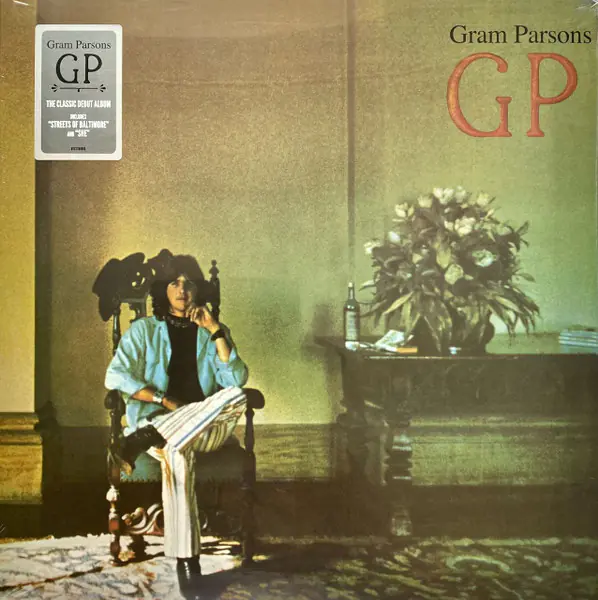
Gram Parsons – GP – 180 Gram Vinyl Record
Some albums don’t announce themselves with grand gestures. They settle in slowly, revealing their character one song at a time until you realize you’re listening to something that quietly changed the course of American music. Gram Parsons’s GP, released in 1973, is one of those records. It wasn’t a commercial success when it appeared, and Parsons would tragically have only one more studio album before his death later that year. Yet its influence has echoed through country, rock, Americana, and alternative country for decades.
By the time he recorded GP, Parsons had already left an extraordinary trail. He had helped reshape The Byrds with Sweetheart of the Rodeo and co-founded The Flying Burrito Brothers, all while championing what he famously called “Cosmic American Music”—a vision that ignored genre boundaries in favor of emotional truth. GP feels like the purest realization of that philosophy. It isn’t trying to be a country record or a rock record. It’s simply chasing great songs wherever they lead.
The album’s emotional center is Parsons himself, but one of its greatest gifts is introducing the wider world to Emmylou Harris. Still early in her recording career, Harris’ harmonies are nothing short of revelatory. She doesn’t merely support Parsons’ vocals; she completes them. Their voices intertwine with an ease that feels almost telepathic, particularly on the duets, where heartbreak and hope seem to occupy the same breath. It’s one of those rare musical partnerships that makes you wonder how either artist ever sang without the other.
Parsons was never a technically flawless singer. His voice could crack, drift slightly behind the beat, or sound almost conversational. Yet those imperfections become part of the music’s appeal. He sings as though he’s confiding in you rather than performing for you, and that intimacy makes songs about love, loneliness, and regret land with uncommon force. There is no theatrical heartbreak here—only lived experience.
The musicians surrounding Parsons are equally remarkable. Guitarist James Burton contributes his trademark Telecaster brilliance, delivering solos that are concise, elegant, and unmistakably rooted in country tradition. The rhythm section understands that these songs don’t need embellishment; they need space. Pedal steel, piano, acoustic guitars, and understated percussion create arrangements that feel timeless because nothing is trying too hard to draw attention to itself.
Lyrically, GP rarely reaches for elaborate metaphors. Parsons writes about love, distance, longing, and redemption in direct language, trusting that honest emotions require little decoration. That simplicity has helped the album age beautifully. It never sounds trapped in the early 1970s because the feelings it explores remain universal.
Perhaps the most remarkable thing about GP is how effortlessly it blends musical traditions. Honky-tonk, gospel, folk, rhythm and blues, rock and roll, and Bakersfield country all coexist without ever feeling stitched together. Parsons wasn’t interested in fusion for its own sake; these influences were simply part of his musical vocabulary. Listening today, the album feels less like a hybrid than a reminder that these styles always belonged together.
Its commercial reception was modest, but its legacy has been immense. Artists ranging from Elvis Costello and Steve Earle to Wilco and Jason Isbell have drawn from the path Parsons helped clear. Modern Americana, in many ways, still lives in the world he imagined.
Listening to GP now, it’s impossible not to hear both fulfillment and unfinished promise. Parsons had finally found the musical language he’d been searching for, yet he was only beginning to explore where it might lead. That bittersweet knowledge adds another emotional layer to an already deeply moving album.
More than fifty years after its release, GP remains one of the defining statements of American roots music. It doesn’t rely on virtuosity, grand concepts, or fashionable production. Its power comes from sincerity, remarkable songs, and the unforgettable blend of Gram Parsons’ searching voice with Emmylou Harris’ luminous harmonies. It’s an album that doesn’t demand attention—it earns devotion.
Brand new, never played and still sealed in the factory plastic
Track Listing
Still Feeling Blue
We’ll Sweep Out The Ashes In The Morning
A Song For You
Streets Of Baltimore
She
That’s All It Took
The New Soft Shoe
Kiss The Children
Cry One More Time
How Much I’ve Lied
Big Mouth Blues